
CONCOURS D’ ENTRÉE AU DOCTORAT (LMD) A L’ UNIVERSITÉ DES FRÈRES MENTOURI - CONSTANTINE 1 : ANNEE 2016/2017

Le Samedi 15 Octobre 2016 L’Université des frères METOURI - Constantine lance l’appel d’offre national, par voie de concours le samedi U15 Octobre 2016 à 07:30U, aux candidatures d’entrée en Doctorats (3P èmeP cycle) dans les filières et spécialités indiquées ci-dessous. Les dossiers de candidature doivent être déposés et enregistrés (avec récépissé de dépôt) auprès des services de Post-Graduation des FACULTES et DEPARTEMENTS concernés du 06 septembre au 06 octobre 2016 (avant 12:00), délai de rigueur. Lieu de dépôt des dossiers : Secrétariat de la Post-Graduation ’’Service Doctorat LMD’’, DEPARTEMENT (suivant la spécialité) et FACULTÉ (suivant la filière) selon les campus, UNIVERSITE DES FRERES MENTOURI – CONSTANTINE1 – ROUTE D’AIN EL BEY CONSTANTINE 25017.
Nouveaux Bacheliers 2016

Cher bachelier… Toutes nos félicitations !
Et bienvenue dans la communauté universitaire !
Télécharger circulaire additive n° 02 du 30 juin 2016
Etape 1:Après l'annonce des résultats du bac,
- Adresse-toi à ton Lycée. On te remettra ton attestation du baccalauréat à travers laquelle tu prendras connaissance de ton NUMÉRO PERSONNEL (en bas de page), qui te servira lors de ta préinscription
- Prends connaissance des informations mises à ta disposition dans le Guide du Bachelier et dans la Circulaire. Nous te conseillons à cet effet, d'installer l'application TASJILCOM, disponible dans l'espace de téléchargement, sur ton smartphone. Tu pourras également utiliser, les versions Flash du Guide et Hypertexte de la Circulaire, sur un P.C; ou encore les versions pdf de ces deux documents.
Etape 2- Après la lecture attentive des documents, tu procéderas à ta préinscription du mardi 19 au jeudi 21 juillet 2016.
Cette phase consiste à remplir ta fiche de vœux et à la déposer, en ligne, à partir de l'adresse suivante : http://www.orientation.esi.dz
Cette opération peut être effectuée là où existe une connexion à l'Internet. Cependant nous te recommandons de rejoindre à cet effet les salles prévues dans tous les établissements universitaires, tu y trouveras disponibilité, conseils, assistance et accès gratuit à l'Internet.
Etape 3: du vendredi 22 au dimanche 24 juillet 2016
Tu dois ensuite confirmer ta préinscription. Il t'est permis aussi de modifier ta précédente fiche de vœux.
Dans ce cas, c'est la deuxième fiche de vœux qui est prise en considération pour ton orientation.
Cas particulier : du dimanche 31 juillet au mardi 02 août 2016
Cas particulier des filières soumises à test d'aptitude ou entretien:
Si tu a choisi des filières soumises à test d'aptitude ou entretien, n'oublie pas de te renseigner auprès des établissements concernés, sur la date précise des épreuves . En effet, il ne te faudra pas risquer de perdre une ou plusieurs formations possibles, du fait d'un chevauchement éventuel d'épreuves. Tes résultats te seront communiqués au plus tard 48 heures avant la clôture des inscriptions définitives.
Etape 5: du jeudi 04 au mardi 09 août 2016
Inscription définitives :
Après avoir pris connaissance de votre affectation, Vous devez procéder à l’inscription définitive.
Etape 4: du dimanche 31 juillet au mardi 02 août 2016
Affectations et recours seront établis en ligne.
Tu peux s'il le faut, introduire un recours dans le cas où aucun de tes six choix n'a été retenu.
Au cas où tu es déclaré non admis, tu seras réorienté dans l'un des autres choix portés sur ta fiche de voeux. L'établissement d'accueil en première affectation est chargé de la procédure de la réorientation.
Education: Degrees of success
Life-science PhD graduates who wish to leave academia often find rewarding careers in the laboratories of biotechnology and pharmaceutical companies. But some find that the lab isn't enough. Researchers who choose to move beyond the bench to the upper levels of the company often decide to add three more letters to their CV: MBA.
Investing time and money in another degree may seem an unappealing prospect for many PhD holders, but that's the reality of the competitive job market: sometimes you have to go beyond the usual training to get the job. An MBA (master of business administration) can open up career possibilities for a biotechnology or drug-development researcher and help them to stand out from the crowd. Those who decide to take the plunge face key questions: how and when to pursue an MBA (see 'When to go for an MBA'), and where to go from there. Many who have travelled this path say that the extra effort to get the degree has paid off by taking their career to the next level.
An MBA can help industrial researchers to move to a higher position and earn more. Jane Rhodes, now a manager for new high-tech initiatives at Biogen, a biotechnology company in Cambridge, Massachusetts, had spent ten years at the company working on drugs for neurological disorders such as Parkinson's and Alzheimer's disease. She felt hemmed in by the lab, but she realized that she didn't have the business or management skills to move up the company ladder. “I came through the British education system, which is very focused,” she says. “I wanted to learn more about the business side of biotech.”
To fill that gap, Rhodes embarked on a two-year MBA programme at Babson College in Wellesley, Massachusetts. Specifically designed for mid-career professionals, the programme took up to 30 hours a week, a big commitment for a researcher who already had a full-time job and a family. The programme would have cost her about US$75,000, but Biogen paid the bulk of the tuition bill, a sign of how much the company values the degree and the person.
Rhodes used her MBA to get her job at Biogen overseeing new company initiatives, a position that would have been off-limits without the extra training in the business side of science. “I can now move to multiple different positions across the company,” she says. “The combination of PhD and MBA is very valuable.” She enjoys thinking beyond the confines of research — and that's only one benefit of her revitalized career. “Without an MBA,” she says, “I don't know if my salary would be anywhere close to what it is now.”
An MBA could give industrial researchers the insight they need to help turn a business around. Looking back, Oréda Boussadia wishes that she'd had that insight in addition to her research skills. She was one of only a few people in the world who knew how to create a certain type of transgenic mouse, thanks to her PhD and postdoctoral training in France and Germany. But she knew nothing about turning mice into profits, which was a problem at the small French biotech company that she joined after her postdoc. “We had very good results, but we had trouble making sales,” she says. The company failed within a year, forcing Boussadia to quickly ponder her next step. “I really wanted to continue in biotech, but I had to refine my management skills,” she says. “I knew how to design a research project, not how to develop a company.”
Boussadia jump-started her career by enrolling in the MBA programme at the Institut Français de Gestion in Nantes, France. Like other MBA schemes, it focused on the practical aspects of business: product development, market analysis, pricing and return on investment, using real-life examples as learning tools. Degree in hand, she soon got a job managing the production and sales of transgenic mice at a branch of Charles River Laboratories in Lyon, France. After holding that job for five years, she is now the European head of business development and strategy for EpiVax, a biotech company in Lyon. She's happy with the course of her career. “I enjoyed research, but it wasn't enough,” she says. “I wanted to be a decision maker.”
New horizons
Armed with an MBA, many can leave the lab without leaving science. As a postdoc, Kyle Rasbach investigated potential therapies for muscular dystrophy at the Dana–Farber Cancer Institute in Boston, Massachusetts. But thanks to the MBA that he'd pursued along with his PhD, he was snapped up after his postdoc for a job studying investment opportunities at investment management firm T. Rowe Price in Baltimore, Maryland. Much of his remit involves evaluating the research taking place at drug companies, from the giants of the business to small start-ups. His lab background helps him to spot blockbuster drugs in the making. “Sixty to seventy per cent of my job is science-based,” he says. “You can't do this job and be excellent at it without a PhD or an MD.”
That's also true for Moritz Fischer, director of international marketing for Fresenius Medical Care in Hessen, Germany. After earning his medical degree at the Ludwig Maximilian University of Munich in Germany, he realized that he did not want a career as a physician or clinician. He took a job at Fresenius as a lower-level marketing manager, but soon recognized that he could go much further with advanced business skills. So he pursued an MBA at Danube University Krems in Austria. The company covered his tuition, which he estimates would have cost him at least €20,000 ($22,500). It was a reasonable investment for the company, he says, because he has made money for them. “They were able to capitalize on my training,” he says.
" I enjoyed research, but it wasn't enough. I wanted to be a decision maker. "
Success stories of researchers with MBAs in biotech and drug development have caught the attention of early-career researchers who are still plotting their careers. Jeffrey Zahratka, a postdoc at the Cleveland Clinic in Ohio, says that he could see himself working at a biotech firm, perhaps one that makes implantable devices to treat neurological disorders. “I could act as a go-between for the research side and the business side,” he says. He still has to weigh up the pros and cons of another degree, but he thinks that he could bring a lot of value to a company. “People with a research background have a lot of tenacity,” he says. “They are battle-tested.”
If he decides to go down the MBA route, he won't be alone. But for now, PhD–MBA remains a relatively rare combination — that factor alone can help a person to stand out and move forward. It's a matter of degree.
CÉRÉMONIE DE CLÔTURE DE L'ANNÉE UNIVERSITAIRE 2015/2016

Fidèle à ses traditions, l’université des Frères Mentouri Constantine organisera la cérémonie de clôture de l’année universitaire 2015/ 2016 et ce le 30 juin 2016 à l’auditorium Mohammed Saddik Ben yahia à partir de 09.30.
Pour cette occasion, le Rectorat récompensera les étudiants classés majors de promotions dans les différents parcours de formations (en Licence, en master et en doctorat) dispensés par les facultés et les instituts de l’Université.
A cet effet, toute la communauté universitaire est cordialement invitée.
International Conference on Integrated Environmental Management for Sustainable Development

|
|
Appel à candidatures pour les formations ouvertes et à distance diplômantes L3, M1 ou M2 (FOAD) 2016-2017

L'AUF propose 88 formations diplômantes pour la promotion 2016-2017 sur sa plate-forme deFormations ouvertes et à distance (FOAD) :
- 7 Diplômes Universitaires en Médecine (DU) ;
- 11 Licences (L3) ;
- 20 Masters 1 ;
- 50 Masters 2.
- Droit, Économie et Gestion ;
- Éducation et formation ;
- Sciences de l’ingénieur ;
- Médecine ........................ Lire la suite

Changement de paradigme dans l'enseignement tertiaire

Amélioration de la qualité et de la gouvernance en faveur de la compétitivité et de l'employabilité du 30 Mai 2016 au 1 Juin2016
La 7ème Edition du Salon de l’Emploi le 1 & 2 Juin 2016

L’Université des Frères Mentouri Constantine avec son Centre des Carrières organise les 1 & 2 Juin 2016, la 7ème Edition du Salon de l’Emploi qui sera placée cette année sous le slogan :
« un Entreprenariat Université/entreprise pour l’insertion professionnelle des diplômés»
A cet effet, les professionnels des secteurs socio-économiques, présenteront aux étudiants des idées de montage d’entreprise, les démarches de candidature à un poste de travail, les profils requis et l’évolution du marché du travail.
Un programme très riche est au RDV lors de ces deux journées tels que : La présentation du projet européen COFFEE qui concerne la co-construction de licences professionnalisantes avec implication du secteur socio-économique, des conférences, des expositions,…
Les Conférences auront lieu à la salle de conférence de la faculté des Lettres et Langues, l’Exposition des stands au Hall du Bloc des Lettres de l’Université des Frères Mentouri Constantine.
Entomology: Nabokov's scientific artistry
Vladimir Lukhtanov delights in a treatise on the luminary's contribution to biology.
Vladimir Nabokov's influence on Russian and English literature and language is assured. Many people also know of the novelist's lifelong passion for butterflies. But his notable contributions to the science of lepidopterology and to general biology are only beginning to be widely known.
Nabokov was no amateur entomologist. He served for six years as curator of the butterfly collection at Harvard University's Museum of Comparative Zoology in Cambridge, Massachusetts, and published a dozen papers on taxonomy — the description and classification of organisms — that remain important. His observations on butterfly morphology have stimulated breakthrough research in evolutionary biology. Several of his original biogeographic hypotheses have been confirmed in the past few years. Fine Lines, a collection edited by Stephen Blackwell and Kurt Johnson, explains the importance of Nabokov's scientific work and traces its influence on his novels.
Reproduced by permission of the V. Nabokov Estate/the Henry A. & Albert W. Berg Collection, New York Public Lib.
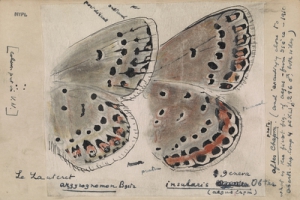
One of Vladimir Nabokov's drawings of the undersurfaces of butterfly wings.
The book begins with 154 of Nabokov's black-and-white and colour drawings of butterflies' fine anatomical structures. Most represent the European, Asian and American species of the 'blues' of the tribe Polyommatini, Nabokov's favourite group. Ten essays follow, by prominent researchers including evolutionary biologist James Mallet, current Harvard butterfly curator Naomi Pierce and lepidopterist Robert Pyle, explaining the interplay of science and art in Nabokov's writings. Fine Lines clearly demonstrates the significant impact that science had on Nabokov's evolution as a writer.
The decision to open the book with the drawings is a masterstroke. They illustrate one of the most important aspects of Nabokov's creativity — his tremendous attention to details, described with scrupulous precision. In his novels, he seamlessly marshals minutiae — impressions, passing fancies, ideas — to create a universe strongly rooted in observation. The particular or apparently trivial was, for him, always worth probing. In his entomological studies, he analysed fine, nearly invisible, dots on the wings of New and Old World butterflies to hint at what may have happened on Earth millions of years ago. With no palaeontological data, Nabokov speculated that North and then South America were populated by five waves of butterflies migrating from Asia ( Psyche 52, 1–61; 1945) — a picture confirmed by DNA analysis almost 70 years on ( et al. Proc. R. Soc. B 278, 2737–2744; 2011).
This pointillism is harder than it seems. Piling up millions of elements can easily end in chaos; to create a picture, one needs to understand the nature of these elements and to be able to choose between them. The core of scientific drawing differs greatly from photography in focusing on the heart of the matter and avoiding unnecessary details. This is important for science, and no less for art. Both have the same central goal — to reveal an unknown or invisible essence of things. That is one of the main points of Fine Lines.
Yet science and art diverge in their communication. In science, the ability to convey the idea properly and simply is a matter of special talent, but almost everyone can learn to do it. Not so in art. Nabokov's drawings are scientifically perfect, but also staggeringly fine aesthetically. They show how the merging of content and form in art conveys ideas wonderfully. However, even the most wonderful idea becomes banal if artistry is lacking.
The personal, artistic and scientific aspects of Nabokov's life were tightly intertwined. As one of the book's essayists, science writer Dorion Sagan, concludes, nature and art were a continuum for him: “the distinct but equally necessary paths of art and science seem to scale opposite sides of the same majestic mountainscape”.
Nabokov's fiction is permeated by science, as Fine Lines amply reveals. He was a master in the use of motif and symbols. In his novel Lolita (Olympia, 1955), for instance, the town Lepingville is named after 'lepping', butterfly hunters' slang for chasing butterflies, and Elphinstone after Elphinstonia, a subgenus in the white butterfly genus Euchloe. The fictional play-within-the-novel, The Enchanted Hunters, is built almost entirely on symbols associated with butterflies. Diana, its protagonist, is both the virgin goddess of hunting and a butterfly species (Speyeria diana). In his essay, Nabokov scholar Brian Boyd reveals that Edusa Gold, who directs the play, is an echo of Colias edusa, an old but preocccupied name for the clouded yellow (now Colias croceus). I can add that her sister Electra Gold was named after Colias electra, an unavailable name for the African clouded yellow, now Colias electo. That these names are effectively hidden — no longer in use, but buried in lists of unavailable scientific epithets — chimes with the secrecy in this controversial novel.
I prepared this review at the Nabokov House Museum in St Petersburg, Russia. While there, I discovered in the Nabokov family's copy of An Illustrated Natural History of British Butterflies and Moths by Edward Newman (William Glaisher, 1870) that Nabokov had, as a child, coloured in the black-and-white image of the clouded yellow with remarkable accuracy. As zoologist Victor Fet describes in Fine Lines, Nabokov's childhood concentration on butterfly collecting and drawing effectively provided very specific training in memory and paying attention, as well as that focus on minute detail.
Few have so beautifully and meaningfully meshed serious scientific endeavour with artistic brilliance, visual and verbal. Fine Lines helps us to understand the phenomenon of creativity, without which neither good science nor true art can exist.
 Twitter
 Facebook