
Journée d'Orientation et de Promotion de l'Investissement Agricole

Le 23 Mai 2016
Campus 500 Places
Programme
|
8h30mn |
Accueil des participants |
|
Cérémonie d’Ouverture |
|
|
10h30 |
Visite des stands |
|
12h30 |
Allocution de Monsieur le Recteur de l’Université des Frères Mentouri Constantine 1 Allocution du Directeur des Services Agricoles de Constantine. Allocution de Monsieur le Wali de la Wilaya de Constantine. Allocution de la Cérémonie Officielle par Monsieur le Ministre de l’Agriculture et du Développement Rural et de la Pêche |
|
|
Pause Café |
|
|
|
|
12h45 |
« Programme de la pisciculture intégrée à l’agriculture » par Dr MAKHZAR Meriem, Chef d’antenne Pêche Constantine |
|
13h00 |
« Les fromages traditionnels Algériens opportunités de développement pour les PME » par AISSAOUI-ZITOUN O. , BENYAHIA F.A. , BOUGHELLOUT H. , ADOUI F. , SIAR H. et ZIDOUNE M.N. INATAA, Equipe : Transformation et Élaboration de Produits Agroalimentaires, Laboratoire de Nutrition et Technologie alimentaire (L.N.T.A.) |
|
13h15 |
« Les nouvelles procédures de partenariat, sur les terres privées de l’état » par Mr GHANEM Hamza, Responsable contentieux, ONTA-Constantine |
|
13h30 |
« Opportunités d’investissement dans l’industrie agro-alimentaire » par DIM Constantine |
|
13h45 |
« Les différents types de crédits liés à l’investissement » par le Directeur de la BADR -GRE- |
|
14h00 |
« Levures oléagineuses : la biotechnologie au service de l’agriculture » par Naila Doria BOUCHEDJA, Abdelghani BOUDJELLAL, Franck DELVIGNE, Sabine DANTHINE INATAA-UFMC, Equipe MAQUAV- Laboratoire BIOQUAL Université Liège-Gembloux/AgroBioTech, unité de sciences des aliments de formulation, Belgique. |
|
14h15 |
« Présentation de l’unité pain sur table et son impact sur la région est-entreprise citoyenne » par Mr ZEROUKI |
|
14h30 |
« La recherche au service du développement du secteur agro-alimentaire » BOUGHALLOUT H. INATAA, Equipe : Transformation et Élaboration de Produits Agroalimentaires, Laboratoire de Nutrition et Technologie alimentaire (L.N.T.A.). |
|
14h45 |
« Valorisation de la paille par l’urée » par Dr MEZIANE Toufi, ISV-Batna |
|
15h00 |
Débat et recommandations |
|
15h30 |
Clôture |
|
|
|
CRISPR: gene editing is just the beginning

Molecular biologists are riding a wave of new technologies made possible by CRISPR.
Whenever a paper about CRISPR–Cas9 hits the press, the staff at Addgene quickly find out. The non-profit company is where study authors often deposit molecular tools that they used in their work, and where other scientists immediately turn to get them. It is also where other scientists immediately turn to get their hands on these reagents. “We get calls within minutes of a hot paper publishing,” says Joanne Kamens, executive director of the company in Cambridge, Massachusetts.
LISTEN
Heidi Ledford talks Noah Baker through the cutting edge of the CRISPR technique
Addgene's phones have been ringing a lot since early 2013, when researchers first reported1, 2, 3 that they had used the CRISPR–Cas9 system to slice the genome in human cells at sites of their choosing. “It was all hands on deck,” Kamens says. Since then, molecular biologists have rushed to adopt the technique, which can be used to alter the genome of almost any organism with unprecedented ease and finesse. Addgene has sent 60,000 CRISPR-related molecular tools — about 17% of its total shipments — to researchers in 83 countries, and the company's CRISPR-related pages were viewed more than one million times in 2015.
Much of the conversation about CRISPR–Cas9 has revolved around its potential for treating disease or editing the genes of human embryos, but researchers say that the real revolution right now is in the lab. What CRISPR offers, and biologists desire, is specificity: the ability to target and study particular DNA sequences in the vast expanse of a genome. And editing DNA is just one trick that it can be used for. Scientists are hacking the tools so that they can send proteins to precise DNA targets to toggle genes on or off, and even engineer entire biological circuits — with the long-term goal of understanding cellular systems and disease.
“For the humble molecular biologist, it's really an extraordinarily powerful way to understand how the genome works,” says Daniel Bauer, a haematologist at the Boston Children's Hospital in Massachusetts. “It's really opened the number of questions you can address,” adds Peggy Farnham, a molecular biologist at the University of Southern California, Los Angeles. “It's just so fun.”
Here, Nature examines five ways in which CRISPR–Cas9 is changing how biologists can tinker with cells.
Nature special: CRISPR
Broken scissors
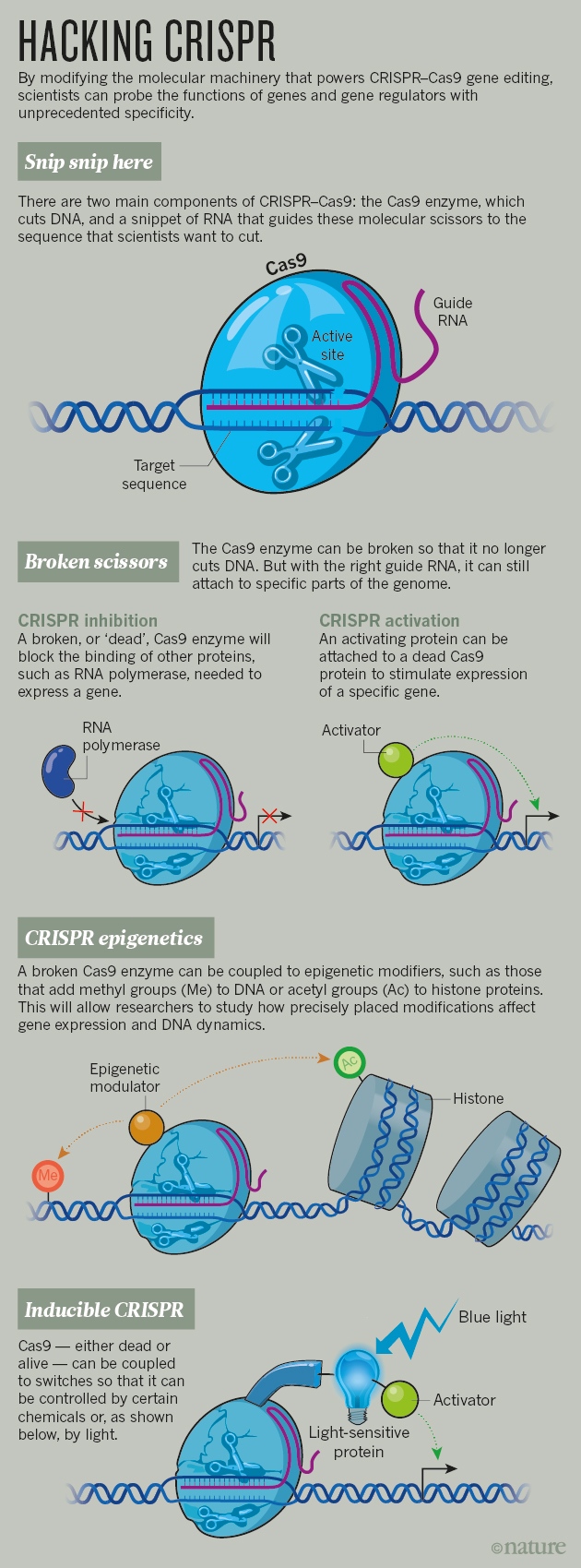
There are two chief ingredients in the CRISPR–Cas9 system: a Cas9 enzyme that snips through DNA like a pair of molecular scissors, and a small RNA molecule that directs the scissors to a specific sequence of DNA to make the cut. The cell's native DNA repair machinery generally mends the cut — but often makes mistakes.
That alone is a boon to scientists who want to disrupt a gene to learn about what it does. The genetic code is merciless: a minor error introduced during repair can completely alter the sequence of the protein it encodes, or halt its production altogether. As a result, scientists can study what happens to cells or organisms when the protein or gene is hobbled.
But there is also a different repair pathway that sometimes mends the cut according to a DNA template. If researchers provide the template, they can edit the genome with nearly any sequence they desire at nearly any site of their choosing.
In 2012, as laboratories were racing to demonstrate how well these gene-editing tools could cut human DNA, one team decided to take a different approach. “The first thing we did: we broke the scissors,” says Jonathan Weissman, a systems biologist at the University of California, San Francisco (UCSF).
Weissman learned about the approach from Stanley Qi, a synthetic biologist now at Stanford University in California, who mutated the Cas9 enzyme so that it still bound DNA at the site that matched its guide RNA, but no longer sliced it. Instead, the enzyme stalled there and blocked other proteins from transcribing that DNA into RNA. The hacked system allowed them to turn a gene off, but without altering the DNA sequence4.
The team then took its 'dead' Cas9 and tried something new: the researchers tethered it to part of another protein, one that activates gene expression. With a few other tweaks, they had built a way to turn genes on and off at will5.
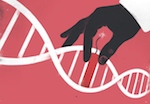
Several labs have since published variations on this method; many more are racing to harness it for their research6 (see 'Hacking CRISPR'). One popular application is to rapidly generate hundreds of different cell lines, each containing a different guide RNA that targets a particular gene. Martin Kampmann, another systems biologist at UCSF, hopes to screen such cells to learn whether flipping certain genes on or off affects the survival of neurons exposed to toxic protein aggregates — a mechanism that is thought to underlie several neurodegenerative conditions, including Alzheimer's disease. Kampmann had been carrying out a similar screen with RNA interference (RNAi), a technique that also silences genes and can process lots of molecules at once, but which has its drawbacks. “RNAi is a shotgun with well-known off-target effects,” he says. “CRISPR is the scalpel that allows you to be more specific.”
Nik Spencer/Nature
Weissman and his colleagues, including UCSF systems biologist Wendell Lim, further tweaked the method so that it relied on a longer guide RNA, with motifs that bound to different proteins. This allowed them to activate or inhibit genes at three different sites all in one experiment7. Lim thinks that the system can handle up to five operations at once. The limit, he says, may be in how many guide RNAs and proteins can be stuffed into a cell. “Ultimately, it's about payload.”
That combinatorial power has drawn Ron Weiss, a synthetic biologist at the Massachusetts Institute of Technology (MIT) in Cambridge, into the CRISPR–Cas9 frenzy. Weiss and his colleagues have also created multiple gene tweaks in a single experiment8, making it faster and easier to build complicated biological circuits that could, for example, convert a cell's metabolic machinery into a biofuel factory. “The most important goal of synthetic biology is to be able to program complex behaviour via the creation of these sophisticated circuits,” he says.
CRISPR epigenetics
When geneticist Marianne Rots began her career, she wanted to unearth new medical cures. She studied gene therapy, which targets genes mutated in disease. But after a few years, she decided to change tack. “I reasoned that many more diseases are due to disturbed gene-expression profiles, not so much the single genetic mutations I had been focused on,” says Rots, at the University Medical Center Groningen in the Netherlands. The best way to control gene activity, she thought, was to adjust the epigenome, rather than the genome itself.
The epigenome is the constellation of chemical compounds tacked onto DNA and the DNA-packaging proteins called histones. These can govern access to DNA, opening it up or closing it off to the proteins needed for gene expression. The marks change over time: they are added and removed as an organism develops and its environment shifts.
In the past few years, millions of dollars have been poured into cataloguing these epigenetic marks in different human cells, and their patterns have been correlated with everything from brain activity to tumour growth. But without the ability to alter the marks at specific sites, researchers are unable to determine whether they cause biological changes. “The field has met a lot of resistance because we haven't had the kinds of tools that geneticists have had, where they can go in and directly test the function of a gene,” says Jeremy Day, a neuroscientist at the University of Alabama at Birmingham.
CRISPR–Cas9 could turn things around. In April 2015, Charles Gersbach, a bioengineer at Duke University in Durham, North Carolina, and his colleagues published9 a system for adding acetyl groups — one type of epigenetic mark — to histones using the broken scissors to carry enzymes to specific spots in the genome.
The team found that adding acetyl groups to proteins that associate with DNA was enough to send the expression of targeted genes soaring, confirming that the system worked and that, at this location, the epigenetic marks had an effect. When he published the work, Gersbach deposited his enzyme with Addgene so that other research groups could use it — and they quickly did. Gersbach predicts that a wave of upcoming papers will show a synergistic effect when multiple epigenetic markers are manipulated at once.
The tools need to be refined. Dozens of enzymes can create or erase an epigenetic mark on DNA, and not all of them have been amenable to the broken-scissors approach. “It turned out to be harder than a lot of people were expecting,” says Gersbach. “You attach a lot of things to a dead Cas9 and they don't happen to work.” Sometimes it is difficult to work out whether an unexpected result arose because a method did not work well, or because the epigenetic mark simply doesn't matter in that particular cell or environment.

Rots has explored the function of epigenetic marks on cancer-related genes using older editing tools called zinc-finger proteins, and is now adopting CRISPR–Cas9. The new tools have democratized the field, she says, and that has already had a broad impact. People used to say that the correlations were coincidental, Rots says — that if you rewrite the epigenetics it will have no effect on gene expression. “But now that it's not that difficult to test, a lot of people are joining the field.”
CRISPR code cracking
Epigenetic marks on DNA are not the only genomic code that is yet to be broken. More than 98% of the human genome does not code for proteins. But researchers think that a fair chunk of this DNA is doing something important, and they are adopting CRISPR–Cas9 to work out what that is.
Some of it codes for RNA molecules — such as microRNAs and long non-coding RNAs — that are thought to have functions apart from making proteins. Other sequences are 'enhancers' that amplify the expression of the genes under their command. Most of the DNA sequences linked to the risk of common diseases lie in regions of the genome that contain non-coding RNA and enhancers. But before CRISPR–Cas9, it was difficult for researchers to work out what those sequences do. “We didn't have a good way to functionally annotate the non-coding genome,” says Bauer. “Now our experiments are much more sophisticated.”
Farnham and her colleagues are using CRISPR–Cas9 to delete enhancer regions that are found to be mutated in genomic studies of prostate and colon cancer. The results have sometimes surprised her. In one unpublished experiment, her team deleted an enhancer that was thought to be important, yet no gene within one million bases of it changed expression. “How we normally classify the strength of a regulatory element is not corresponding with what happens when you delete that element,” she says.
“I wish I had had this technology sooner. My postdoc would have been a lot shorter.”
More surprises may be in store as researchers harness CRISPR–Cas9 to probe large stretches of regulatory DNA. Groups led by geneticists David Gifford at MIT and Richard Sherwood at the Brigham and Women's Hospital in Boston used the technique to create mutations across a 40,000-letter sequence, and then examined whether each change had an effect on the activity of a nearby gene that made a fluorescent protein10. The result was a map of DNA sequences that enhanced gene expression, including several that had not been predicted on the basis of gene regulatory features such as chromatin modifications.
Delving into this dark matter has its challenges, even with CRISPR–Cas9. The Cas9 enzyme will cut where the guide RNA tells it to, but only if a specific but common DNA sequence is present near the cut site. This poses little difficulty for researchers who want to silence a gene, because the key sequences almost always exist somewhere within it. But for those who want to make very specific changes to short, non-coding RNAs, the options can be limited. “We cannot take just any sequence,” says Reuven Agami, a researcher at the Netherlands Cancer Institute in Amsterdam.
Researchers are scouring the bacterial kingdom for relatives of the Cas9 enzyme that recognize different sequences. Last year, the lab of Feng Zhang, a bioengineer at the Broad Institute of MIT and Harvard in Cambridge, characterized a family of enzymes called Cpf1 that work similarly to Cas9 and could expand sequence options11. But Agami notes that few alternative enzymes found so far work as well as the most popular Cas9. In the future, he hopes to have a whole collection of enzymes that can be targeted to any site in the genome. “We're not there yet,” he says.
CRISPR sees the light
Gersbach's lab is using gene-editing tools as part of an effort to understand cell fate and how to manipulate it: the team hopes one day to grow tissues in a dish for drug screening and cell therapies. But CRISPR–Cas9's effects are permanent, and Gersbach's team needed to turn genes on and off transiently, and in very specific locations in the tissue. “Patterning a blood vessel demands a high degree of control,” he says.

Gersbach and his colleagues took their broken, modified scissors — the Cas9 that could now activate genes — and added proteins that are activated by blue light. The resulting system triggers gene expression when cells are exposed to the light, and stops it when the light is flicked off12. A group led by chemical biologist Moritoshi Sato of the University of Tokyo rigged a similar system13, and also made an active Cas9 that edited the genome only after it was hit with blue light14.
Others have achieved similar ends by combining CRISPR with a chemical switch. Lukas Dow, a cancer geneticist at Weill Cornell Medical College in New York City, wanted to mutate cancer-related genes in adult mice, to reproduce mutations that have been identified in human colorectal cancers. His team engineered a CRISPR–Cas9 system in which a dose of the compound doxycycline activates Cas9, allowing it to cut its targets15.
The tools are another step towards gaining fine control over genome editing. Gersbach's team has not patterned its blood vessels just yet: for now, the researchers are working on making their light-inducible system more efficient. “It's a first-generation tool,” says Gersbach.
Model CRISPR
Cancer researcher Wen Xue spent the first years of his postdoc career making a transgenic mouse that bore a mutation found in some human liver cancers. He slogged away, making the tools necessary for gene targeting, injecting them into embryonic stem cells and then trying to derive mice with the mutation. The cost: a year and US$20,000. “It was the rate-limiting step in studying disease genes,” he says.
A few years later, just as he was about to embark on another transgenic-mouse experiment, his mentor suggested that he give CRISPR–Cas9 a try. This time, Xue just ordered the tools, injected them into single-celled mouse embryos and, a few weeks later — voilá. “We had the mouse in one month,” says Xue. “I wish I had had this technology sooner. My postdoc would have been a lot shorter.”
Researchers who study everything from cancer to neurodegeneration are embracing CRISPR-Cas9 to create animal models of the diseases. It lets them engineer more animals, in more complex ways, and in a wider range of species. Xue, who now runs his own lab at the University of Massachusetts Medical School in Worcester, is systematically sifting through data from tumour genomes, using CRISPR–Cas9 to model the mutations in cells grown in culture and in animals.
Researchers are hoping to mix and match the new CRISPR–Cas9 tools to precisely manipulate the genome and epigenome in animal models. “The real power is going to be the integration of those systems,” says Dow. This may allow scientists to capture and understand some of the complexity of common human diseases.
Take tumours, which can bear dozens of mutations that potentially contribute to cancer development. “They're probably not all important in terms of modelling a tumour,” says Dow. “But it's very clear that you're going to need two or three or four mutations to really model aggressive disease and get closer to modelling human cancer.” Introducing all of those mutations into a mouse the old-fashioned way would have been costly and time-consuming, he adds.
Bioengineer Patrick Hsu started his lab at the Salk Institute for Biological Studies in La Jolla, California, in 2015; he aims to use gene editing to model neurodegenerative conditions such as Alzheimer's disease and Parkinson's disease in cell cultures and marmoset monkeys. That could recapitulate human behaviours and progression of disease more effectively than mouse models, but would have been unthinkably expensive and slow before CRISPR–Cas9.
Even as he designs experiments to genetically engineer his first CRISPR–Cas9 marmosets, Hsu is aware that this approach may be only a stepping stone to the next. “Technologies come and go. You can't get married to one,” he says. “You need to always think about what biological problems need to be solved.”
هيئــات لمتابعــة الإدمــاج المهنــي لخريجــي جامعــة منتــوري

سخرت جامعة الإخوة منتوري بقسنطينة، العديد من الهيئات لمتابعة و تسيير الإدماج المهني للطلبة المتخرجين بخصوص خلق مؤسسات استثمارية، و ذلك بهدف إنجاح التكامل بين الجامعة و القطاعين الاقتصادي و الاجتماعي، و كذا المحافظة على التواصل بين القطبين.
و حسب ما ورد في بيان من رئاسة الجامعة، فإن الأخيرة التزمت منذ عدة سنوات بدفع الإدماج المهني للطلبة المتخرجين كاهتمام أساسي من خلال وضع عدة أجهزة لإبقاء التواصل مع القطاع الاقتصادي و الاجتماعي، و هي علاقة يمكن أن تتحقق، يضيف البيان، بتنظيم التعليم في المجال المؤسساتي بحيث يصبح التكوين الذي يزاوله الطالب في المؤسسة عنصرا أساسيا يسمح بالإدماج المهني، إضافة إلى برمجة أكبر عدد من المتخرجين في نهاية الدورة سواء في شهادة الليسانس أو الماستر، بتأطير مختلط بين الأكاديميين و المهنيين في إطار العقود المبرمة ما بين جامعة الإخوة منتوري و الشركات الاقتصادية و الاجتماعية، و كذا إقحام المهنيين في مختلف التكوينات في شهادة ليسانس أو ماستر خاصة في الدورات المهنية، مع مساهمة الشريك الاقتصادي في هيئات المحلفين لتقييم مذكرات التخرج.
كما سمحت الإجراءات المتخذة بوصول المعلومة خاصة في مجال اللقاءات بين المعاهد و المؤسسات المعنية بالعمالة، و إدماج وضع "الطالب صاحب المؤسسة" مع ضمان مرافقة دار المقاولاتية لمدة سنة، و هي عملية ترتكز على عدة محاور لإنجاح الإدماج المهني للمتخرجين في القطاعين الاقتصادي و الاجتماعي، أولها الترويج و التسويق للتكوين المقترح من طرف الجامعة، و كذا مرافقة المتخرجين لوضع السير الذاتية عن طريق مركز المسارات المهنية، إضافة إلى دعم و رعاية المؤسسات و تحضير الطلبة لاقتحام عالم الشغل من خلال مختلف المشاريع المهنية، مع اقتراح حلول مبتكرة للشركة المستهدفة.
كما ورد في ذات البيان، أنه قد تم إقحام البحث الجامعي لتحقيق الاندماج مع القطاعين الاقتصادي و الاجتماعي، من خلال تقوية قدرات الجامعة في ما يخص آداءات الخدمات في الدراسة و البحث و الخبرة و تحويل الأطروحات إلى مؤسسات فعلية و تمويلها، و كذا تثمين نتائج البحث و وضع المعدات اللازمة، كما سخرت الجامعة هياكل نشطة لتسيير و متابعة الإدماج المهني للمتخرجين، كمكتب الربط بين الجامعة و المؤسسة المكلف بتنظيم متابعة التربصات، دار المقاولاتية لخلق المؤسسات، و كذا مركز المسارات المهنية المخصص للتوظيف و النادي الجامعي.
خ/ض
Colloque international sur le plurilinguisme: Nécessité de «dépassionner le débat»

« L'Algérie est un pays riche en langues, un pays riche en cultures et en tant que chercheurs on se doit de réfléchir sur la manière d'intégrer toutes les langues en présence dans le processus de l'enseignement apprentissage», nous a déclaré hier le professeur Cherrad Nedjma, enseignante-chercheuse à la faculté des lettres et des langues de l'Université Mentouri de Constantine à l'ouverture du colloque international sur «les dynamiques plurilingues, usages et enseignement des langues» qui se tient les 9 et 10 mai en cours dans le bloc 500 places pédagogiques de cette université. Notre interlocutrice qui fait partie du comité scientifique du colloque indiquera que ce dernier s'articule sur trois volets de recherche : l'enseignement apprentissage dans les situations plurilingues, le plurilinguisme dans le contexte social et le plurilinguisme dans le contexte institutionnel. «L'objectif a été d'abord de réunir un grand nombre de chercheurs de renommée internationale à travers le monde». Elle poursuivra en notant qu'il y a des invités de France, de Tunisie, de Turquie qui viennent partager avec une palette de chercheurs algériens des universités de Tizi-Ouzou, Batna, Mascara, Mostaganem et de Constantine, leurs différentes approches des situations plurilingues, «afin que l'on puisse étudier ce phénomène en dépassionnant le débat. La langue étant véhicule de l'identité, de la culture parfois, il nous est trop compliqué, en tant que locuteurs, d'objectiver l'objet langue à enseigner, autrement dit de le rendre comme étant un objet qu'on peut examiner comme on examine un malade». En somme, l'objectif est d'étudier le rôle du plurilinguisme dans l'enseignement apprentissage des langues, comment intégrer les langues dans le cursus scolaire, quelles sont les politiques linguistiques et éducatives mises en œuvre, comment est-ce qu'on peut les évaluer et comment on peut rendre cet enseignement apprentissage plus pertinent.
«Nous n'avons pas la prétention d'apporter des solutions, mais au moins d'avoir des résultats, des approches qui pourraient permettre aux enseignants et chercheurs d'améliorer l'enseignement apprentissage, notamment. Dalila Morsly, professeur émérite à la retraite de l'université d'Angers (France) mais qui fait toujours partie du laboratoire sciences du langage, analyse des discours didactiques (SLADD) de l'université de Constantine, et a enseigné souvent à l'université Mentouri, participe au colloque par une communication sur «les petites annonces de la presse algérienne». Elle dira à ce propos : «J'ai présenté un travail que j'ai effectué sur la presse pour montrer le fonctionnement du plurilinguisme dans la presse et en particulier dans les petites annonces.
J'ai constaté que dans les petites annonces comme dans de nombreuses autres rubriques de journaux algériens, qu'ils soient de langue française ou arabe, il y avait souvent plusieurs langues qui apparaissaient, des langues en contact. Et je m'intéresse à la façon dont les langues différentes apparaissent dans la rubrique des petites annonces, en particulier dans les offres d'emploi, pour essayer de comprendre quel est le rôle des langues dans les propositions d'offre d'emploi dans la société algérienne».
Concours d'accès aux écoles nationales supérieures
*Si vous êtes parmi les meilleurs titulaires des deux premières années de licence
** Si vous n’avez pas redoublé.
*** Si vous êtes titulaires du Bac 2013 (L3) ou 2014 (L2).
Les dossiers doivent être déposés à la direction des études des écoles préparatoires de la région selon les tableaux suivants ou au niveau des vice-rectorats des universités qui les transmettront aux écoles correspondantes dans les tableaux suivants Date limite de dépôt ou d’acheminement au niveau des écoles: le 31 mai 2016.
PROGRAMME LICENCE BIOINFORMATIQUE
Mille milliards d'espèces biologiques vivent sur terre

WASHINGTON - La Terre pourrait abriter près de mille milliards d'espèces dont seulement 0,001% serait aujourd'hui identifié selon une étude américaine publiée lundi.
Publiée par la revue américaine Proceedings of the National Academy of Sciences (Comptes-rendus de l'Académie américaine des Sciences), l'estimation repose sur des données représentant plus de 5,6 millions d'espèces microscopiques et non-microscopiques évoluant dans 35 000 lieux, dans tous les océans et sur tous les continents du monde, à l'exception de l'Antarctique.
"Estimer le nombre d'espèces vivant sur la Terre est l'un des plus grands défis de la biologie,'' a indiqué l'auteur principal, professeur associé à l'université de l'Indiana, Jay Lennon,'' dans un communiqué. ''Notre étude apparie les plus grands ensembles de données disponibles avec des modèles écologiques et de nouvelles règles écologiques expliquant pourquoi la biodiversité est synonyme de profusion. Cela nous a permis d'obtenir une estimation nouvelle et rigoureuse du nombre d'espèces microbiennes présentes sur la Terre.''
Plusieurs tentatives précédentes, ajoute M. Lennon, avaient tout simplement ignoré les micro-organismes ou n'avaient pris en compte que des ensembles de données anciennes qui reposaient sur des techniques biaisées ou des extrapolations discutables.
Au cours de ces dernières années, la prise de conscience que les micro-organismes étaient significativement sous-échantillonnés a favorisé une explosion des efforts déployés en matière d'échantillonnage des espèces microbiennes, a dit M. Lennon.
Ces efforts ont inclus la collecte des micro-organismes du corps humain par le Projet sur le microbiome humain des Instituts nationaux de Santé des Etats-Unis, des micro-organismes marins par l'expédition Tara Oceans, et des micro-organismes aquatiques, terrestres et liés aux hôtes par le Projet sur le microbiome de la Terre.
Ces sources de données et de nombreuses autres ont été compilées afin de créer l'inventaire, dans la nouvelle étude, qui a rassemblé 20 376 procédures d'échantillonnage sur les bactéries, archées et champignons microscopiques et 14 862 procédures d'échantillonnage sur les communautés d'arbres, d'oiseaux et de mammifères.
Les résultats de l'étude ont également suggéré que parvenir à effectivement identifier chacune des espèces microbiennes présentes sur la Terre est un défi énorme qui dépasse presque l'entendement.
Par exemple, le Projet sur le microbiome de la Terre - un projet mondial multidisciplinaire visant à identifier les organismes microscopiques - n'a à ce jour répertorié qu'à peine 10 millions d'espèces.
"Parmi ces espèces classifiées, seulement environ 10 000 ont vu le jour en laboratoire, et moins de 100 000 ont des séquences répertoriées,'' explique M. Lennon. ''Nos résultats montrent que 100 000 fois plus de micro-organismes n'ont toujours pas été découverts et que 100 millions d'autres ont encore besoin d'être complètement explorés. La biodiversité microbienne est bien plus vaste, semble-t-il, que nous ne l'avons jamais imaginée".
Découverte de la presque la totalité des anomalies génétiques à l’origine des cancers du sein
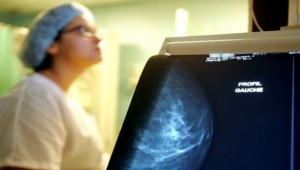
PARIS – Des chercheurs ont découvert pratiquement toutes les anomalies génétiques à l’origine des cancers du sein, une « avancée majeure » qui pourrait permettre de développer de nouveaux traitements plus efficaces contre cette maladie, révèle une étude publiée mardi dans la revue britannique « Nature ».
« C’est une avancée majeure dans la compréhension des mécanismes dans nos cellules qui, lorsqu’ils sont altérés, aboutissent à des cancers du sein », souligne Christine Chomienne, directrice de recherche à l’Institut français du cancer (InCA) qui a co-dirigé l’étude avec l’Institut Sanger à Cambridge (Royaume-Uni).
Elle ajoute que l’étude a permis d’établir « un catalogue quasi exhaustif des anomalies qui interviennent dans les cancers du sein ».
Tous les cancers sont dus à des mutations qui se produisent dans l’ADN de nos cellules au cours de notre vie. Ces changements interviennent à cause de l’environnement mais également au fur et à mesure du vieillissement.
En séquençant le génome complet de l’ADN de 560 tumeurs du sein provenant de plusieurs pays, les chercheurs ont identifié plus de 1.600 anomalies suspectées d’être à l’origine des tumeurs. Les anomalies portent sur 93 gènes différents, dont 10 sont altérés dans plus de la moitié des tumeurs du sein.
Certaines de ces altérations étaient déjà connues tandis que d’autres ont été identifiées pour la première fois grâce au séquençage entier du génome qui a permis d’étudier 100% des gènes, alors que jusqu’alors les anomalies connues n’avaient été identifiées qu’au niveau de 10% des gènes.
Cinq nouveaux gènes impliqués dans les cancers du sein ont ainsi été découverts grâce à cet énorme travail mené dans le cadre du consortium international de génomique du cancer (ICGC) mis en place en 2008.
« Ces gènes n’étaient pas jusque-là associés aux cancers du sein », note Mme Chomienne qui espère que cette découverte permettra de trouver de nouveaux traitements ciblés.
« Il est crucial de trouver ces mutations pour comprendre les causes du cancer et développer de nouvelles thérapies », souligne de son côté le Pr Mike Stratton, du Sanger Institute.
Des traitements ciblés existent d’ores et déjà, comme l’Herceptin (trastuzumab) qui permet de cibler des mutations qu’on retrouve dans 15 à 20% des cancers du sein avec métastases.
Selon la directrice d’InCA, l’étude a également permis de trouver des mutations proches des mutations BRCA1 et BRCA2 qui sont présentes dans certains cancers du sein familiaux.
« Les traitements déjà proposés à ces patientes pourraient également s’avérer efficaces chez celles possédant des mutations proches », estime-t-elle.
COFFEE le projet national structurel qui concerne l’Algérie
L’acronyme COFFEE signifie Co-construction d’une Offre de Formation à Finalité d’Employabilité Elevée. COFFEE est un projet structurel national, financé par le programme Erasmus+ Capacity Building, pour une durée de 3 ans à partir d’Octobre 2015. Il est piloté par l’Université de Montpellier.
COFFEE est un projet national structurel qui concerne l’Algérie. Le consortium implique neuf universités, le ministère de l’éducation supérieur et de la recherche scientifique, trois représentants du monde socio-économique (deux algériens et un européen), ainsi que cinq partenaires universitaires européens.
L’objectif premier du projet est de proposer une structure et une méthodologie permettant de créer en Algérie des licences professionnalisantes visant une forte employabilité des diplômés. Les objectifs induits sont de :
- renforcer la coopération au niveau national entre les représentants du monde socio-économique et les représentants du monde universitaire,
- améliorer l’image de marque des licences professionnalisantes
Les objectifs opérationnels du projet se traduisent par :
- une matrice structurelle définissant un cadre pour la création de licences pilotes,
- une procédure de co-construction de ces licences pilotes,
- une plateforme collaborative d’après projet qui permettra la poursuite de la démarche COFFEE pour la création de nouvelles licences professionnalisantes,
- un répertoire des formations, compétences et métiers permettant de mettre en visibilité la relation entre diplômes, compétences et emplois,
- un réseau de spécialistes formés à l’APC (Approche par Compétences) pour la définition des licences,
- dix-huit licences pilotes.
The black-hole collision that reshaped physics
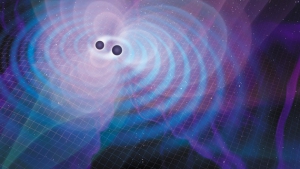
A momentous signal from space has confirmed decades of theorizing on black holes — and launched a new era of gravitational-wave astronomy.
Article tools
Illustration by Mark Garlick
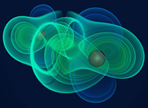
Binary black holes radiate a huge amount of orbital energy as gravitational waves.
The event was catastrophic on a cosmic scale — a merger of black holes that violently shook the surrounding fabric of space and time, and sent a blast of space-time vibrations known as gravitational waves rippling across the Universe at the speed of light.
But it was the kind of calamity that physicists on Earth had been waiting for. On 14 September, when those ripples swept across the freshly upgraded Laser Interferometer Gravitational-Wave Observatory (Advanced LIGO), they showed up as spikes in the readings from its two L-shaped detectors in Louisiana and Washington state. For the first time ever, scientists had recorded a gravitational-wave signal.

“There it was!” says LIGO team member Daniel Holz, an astrophysicist at the University of Chicago in Illinois. “And it was so strong, and so beautiful, in both detectors.” Although the shape of the signal looked familiar from the theory, Holz says, “it's completely different when you see something in the data. It's this transcendent moment”.
The signal, formally designated GW150914 after the date of its occurrence and informally known to its discoverers as 'the Event', has justly been hailed as a milestone in physics. It has provided a wealth of evidence for Albert Einstein's century-old general theory of relativity, which holds that mass and energy can warp space-time, and that gravity is the result of such warping. Stuart Shapiro, a specialist in computer simulations of relativity at the University of Illinois at Urbana–Champaign, calls it “the most significant confirmation of the general theory of relativity since its inception”.
But the Event also marks the start of a long-promised era of gravitational-wave astronomy. Detailed analysis of the signal has already yielded insights into the nature of the black holes that merged, and how they formed. With more events such as these — the LIGO team is analysing several other candidate events captured during the detectors' four-month run, which ended in January — researchers will be able to classify and understand the origins of black holes, just as they are doing with stars.
Still more events should appear starting in September, when Advanced LIGO is scheduled to begin joint observations with its European counterpart, the Franco–Italian-led Advanced Virgo facility near Pisa, Italy. (The two collaborations already pool data and publish papers together.) This detector will not only contribute crucial details to events, but could also help astronomers to make cosmological-distance measurements more accurately than before.
“It's going to be a really good ride for the next few years,” says Bruce Allen, managing director of the Max Planck Institute for Gravitational Physics in Hanover, Germany.
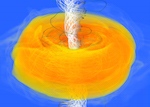
“The more black holes they see whacking into each other, the more fun it will be,” says Roger Penrose, a theoretical physicist and mathematician at the University of Oxford, UK, whose work in the 1960s helped to lay the foundation for the theory of the objects. “Suddenly, we have a new way of looking at the Universe.”
A matter of energy
Physicists have known for decades that every pair of orbiting bodies is a source of gravitational waves. With each revolution, according to Einstein's equations, the waves will carry away a tiny fraction of their orbital energy. This will cause the objects to move a bit closer together and orbit a little faster. For familiar pairs, such as the Moon and Earth, such energy loss is imperceptible even on timescales of billions of years.
But dense objects in very close orbits can lose energy much more quickly. In 1974, radio astronomers Russell Hulse and Joseph Taylor, then of the University of Massachusetts Amherst, found just such a system: a pair of dense neutron stars in orbit around each other. As the years went by, the scientists found that this 'binary pulsar' was losing energy and spiralling inwards exactly as predicted by Einstein's theory.
The two black holes detected by LIGO had probably been losing energy in this way for millions, if not billions, of years before they reached the end. But LIGO did not register the gravitational waves coming from them until 9:50:45 Coordinated Universal Time on 14 September, when the wave's frequency rose above some 30 cycles per second (hertz) — corresponding to 15 full black-hole orbits per second — and was finally high enough for the detectors to distinguish it from background noise.

But then, in just 0.2 seconds, LIGO watched the signal surge to 250 hertz and suddenly disappear, as the black holes made their final 5 orbits, reached orbital velocities of half the speed of light and coalesced into a single massive object (see 'What made the wave').
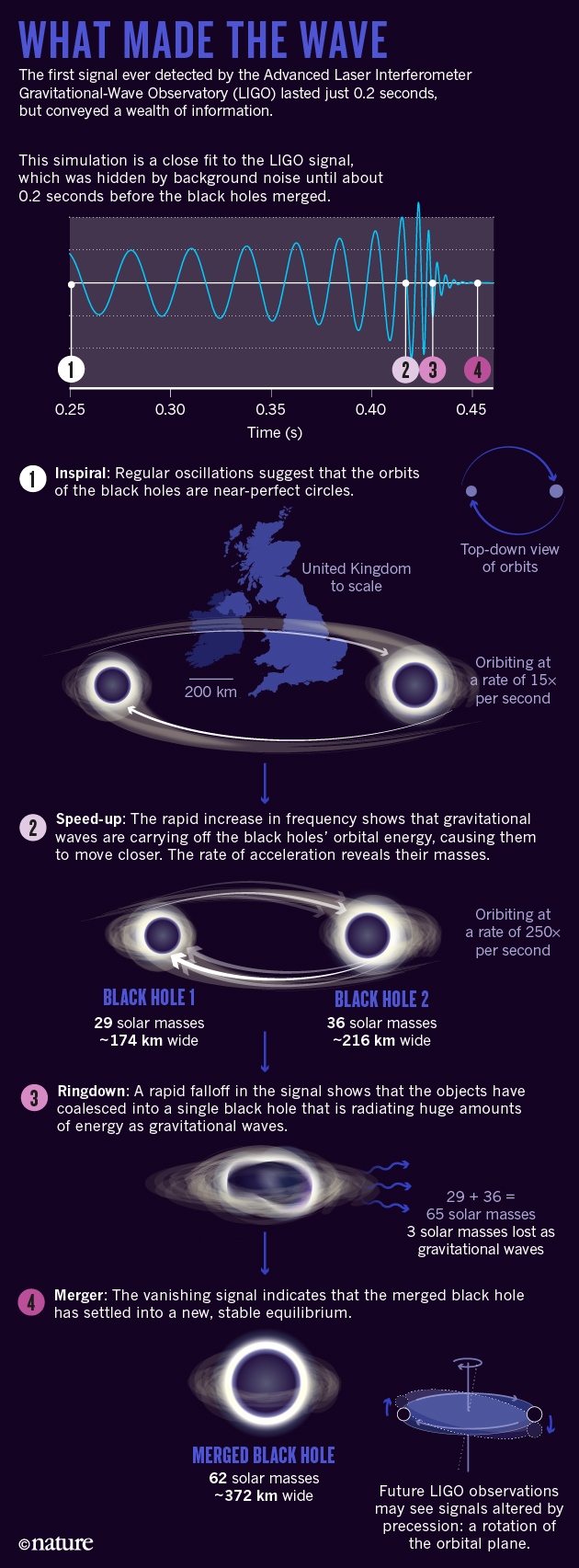
Source: Ref. [1]/Nik Spencer/Nature
The LIGO and Virgo teams soon went to work extracting every bit of information possible. At the most fundamental level, the signal gave them an existence proof: the fact that the objects came so close to each other before merging meant that they had to be black holes, because ordinary stars would need to be much bigger. “It is, I think, the clearest indication that black holes are really there,” says Penrose.
The signal also provided researchers with the first empirical test of general relativity beyond regions — including the space around the binary pulsar — where there is comparatively little space-time warping. There was no empirical evidence that the theory would keep its validity at the extreme energies of merging black holes, says Shapiro — but it did.
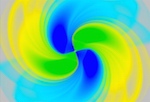
The signal held a trove of more-detailed information as well. By scrutinizing its shape just before the final cataclysm, the scientists found that it closely approximated a simple sine wave with a steadily increasing frequency and amplitude. According to B. S. Sathyaprakash, a theoretical physicist at Cardiff University, UK, and a senior LIGO researcher, this pattern suggests that the orbits of the black holes were nearly circular, and that LIGO probably had a bird's-eye view of the circles, looking almost straight down on them rather than edge-on.
In addition, the LIGO and Virgo teams were able to use the frequency of the observed wave, along with its rate of acceleration, to estimate the masses of the two black holes: because heavier objects radiate energy in the form of gravitational waves at a faster rate than do lighter objects, their pitch rises more quickly.
By recreating the Event with computer simulations, the scientists calculated that the two black holes weighed about 36 times and 29 times the mass of the Sun, respectively, and that the combined black hole weighed about 62 solar masses1. The lost difference, about three Suns' worth, was dispersed as gravitational radiation — much of it during what physicists call the 'ringdown' phase, when the merged black hole was settling into a spherical shape. (For comparison, the most powerful thermonuclear bomb ever detonated converted only about 2 kilograms of matter into energy — roughly 1030 times less.) The teams also suspect that the final black hole was spinning at perhaps 100 revolutions per second, although the margin of error on that estimate is large.
The inferred masses of the two black holes are also revealing. Each object was presumably the remnant of a very massive star, with the larger star approaching 100 times the mass of the Sun and the smaller one a little less. Thermonuclear reactions are known to convert hydrogen in the cores of such stars into helium much faster than in lighter stars, which leads them to collapse under their own weight only a few million years after they are born. The energy released by this collapse causes an explosion called a type II supernova, which leaves behind a residual core that turns into a neutron star or, if it's massive enough, a black hole.
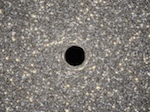
Scientists say that type II supernovae should not produce black holes much bigger than about 30 solar masses — and both black holes were at the high end of that range. This could mean that the system formed from interstellar gas clouds that were richer in hydrogen and helium than the ones typically found in our Galaxy, and that were poorer in heavy elements — which astronomers call metals.
Astrophysicists have calculated that stars formed from such low-metallicity clouds should have an easier time forming massive black holes when they explode, explains Gijs Nelemans, an astronomer at Radboud University Nijmegen in the Netherlands and a member of the Advanced Virgo collaboration. That's because during a supernova explosion, smaller atoms are less likely to be blown away by the blast. Low-metallicity stars thus “lose less mass, so more of it goes into the black hole, for the same initial mass”, Nelemans says.
Two by two
But how did these two black holes end up in a binary system? In a paper2 published at the same time as the one reporting the discovery, the LIGO and Virgo teams described two commonly accepted scenarios.
The simplest one is that two massive stars were born as a binary-star system, forming from the same interstellar gas cloud like a double-yolked egg, and orbiting each other ever since. (Such binary stars are common in our Galaxy; singletons such as the Sun are the exception, rather than the rule.) After a few million years, one of the stars would have burned out and gone supernova, soon to be followed by the other. The result would be a binary black hole.
The second scenario is that the stars formed independently, but still inside the same dense stellar cluster — perhaps one similar to the globular clusters that orbit the Milky Way. In such a cluster, massive stars would sink towards the centre and, through complex interactions with lighter stars, form binary systems, possibly long after their transformation into black holes.
“It is, I think, the clearest indication that black holes are really there.”
Simulations made by Simon Portegies Zwart, an astrophysicist at Leiden University in the Netherlands, show3 that massive stars are more likely to form in dense clusters, where collisions and mergers are more common. He also finds that once a binary black-hole system forms, the complex dynamics of the cluster's centre would probably kick the pair out at high speed. The binary that Advanced LIGO detected may have wandered away from any galaxy for billions of years before merging, he says.
Although the LIGO and Virgo teams were able to learn a lot from the Event, there is much more that gravitational waves could teach them, even in the case of black-hole mergers.The detectors showed that immediately after the black holes merged, the waves quickly died down as the resulting black hole settled into a symmetrical shape. This is consistent with predictions made by theoretical physicist C. V. Vishveshwara in the early 1970s, a time when “gravitational waves and black holes both belonged to the realm of mythology”, he says. “At that time, I had not imagined that it would ever be verified,” says Vishveshwara, who is director emeritus of the Jawaharlal Nehru Planetarium in Bangalore, India.
But LIGO saw only just over one cycle of the Event's ringdown waves before the signal became buried once more in the background noise — not yet enough data to provide a rigorous test of Vishveshwara's predictions.
More-stringent tests will be possible if and when LIGO detects black-hole mergers that are larger than this one, or that occur closer to Earth than the Event's estimated distance of 1.3 billion light years, and thus give 'louder' waves that stay above the noise for longer.
Alessandra Buonanno, a LIGO theorist and director of the Max Planck Institute for Gravitational Physics in Potsdam-Golm, Germany, says that a more detailed picture of the ringdown stage could reveal how fast the final black hole rotates, as well as whether its formation gave it a 'natal kick', imparting a high velocity.
In addition, says Sathyaprakash, “we are especially waiting for systems that are much lighter, so they last longer”. Such events could include the mergers of lighter binary black holes, of binary neutron stars or of a black hole with a neutron star. Each type would deliver its own signature chirp, and could produce a signal that stays above LIGO's threshold of sensitivity for several minutes or more.
“GW150914 is in some sense a very vanilla system,” says Chad Hanna, a LIGO member at Pennsylvania State University in University Park. “It's beautiful, of course, but it doesn't have all the crazy things that one might expect.”
Space artistry
One phenomenon that Sathyaprakash is eager to observe is a 'precession' of the black holes' orbital plane, meaning that their paths trace a kind of 3D rosette. This is a relativistic effect that has no counterpart in Newtonian gravity, and it should produce a characteristic fluctuation in the strength of the gravitational waves. But orbital precession occurs only when two black holes have axes of rotation that point in random directions, and it disappears when the axes are both perpendicular to the orbital plane. The occurrence of a precession could provide clues to how the black holes formed.
It's hard to be sure about that possibility because there are many uncertainties in simulating supernovas. But astrophysicists suspect that parallel spins generally signify that the original two stars were born together out of the same whirling gas cloud. Similarly, they think that random spins result from black holes that formed separately and later fell into orbit around each other. Once the observatories find more mergers, they may be able to determine which type of system occurs more frequently.
Although detecting more events will help LIGO to do lots of science, its interferometers have intrinsic limitations that make it necessary to work together with a worldwide network of similar detectors that are now coming online.

First, LIGO's two interferometers are not enough for scientists to determine precisely where the waves came from. The researchers can get some information by comparing the signal's time of arrival at each detector: the difference enables them to calculate the wave's direction relative to an imaginary line drawn between the two. But in the case of the Event, which recorded a difference of 6.9 milliseconds, their calculations limited the field of possibilities merely to a wide strip of southern sky.
Had Virgo been online, the scientists could have narrowed down the direction substantially by comparing the waves' arrival times at three places. With a fourth interferometer (Japan is building an underground one called KAGRA, for Kamioka Gravitational-Wave Detector, and India has its own LIGO in planning), their precision would improve much more.
Knowing an event's direction will in turn remove one of the biggest uncertainties in determining its distance from Earth. Waves that approach from a direction exactly perpendicular to the detector — either from above or from below, through Earth — will be recorded at their actual amplitude, explains Fulvio Ricci, a physicist at the University of Rome La Sapienza and the spokesperson for Virgo. Waves that come from elsewhere in the sky, however, will hit the detector at an angle and produce a somewhat smaller signal, according to a known formula. There are even some blind spots, where a source cannot be seen by a given detector at all.
Determining the direction will therefore reveal the exact amplitude of the waves. By comparing that figure with the waves' amplitude at the source, which the researchers can derive from the shape of the signal, and by knowing how the amplitude decreases with distance, which they get from Einstein's theory, they can then calculate the distance of the source to a much higher precision.
This situation is almost unprecedented: conventionally, astronomical distances need to be estimated by looking at the brightness of known objects in locations that range from the Solar System to distant galaxies. But the measured brightness of those 'standard candles' can be dimmed by stuff in between. Gravitational waves have no such limitation.
Raising the alarm
There is another important reason why scientists are eager to have precise estimates of the waves' provenance. The LIGO and Virgo teams have arranged to give near-real-time alerts of intriguing events to more than 70 teams of conventional astronomers, who will use their optical, radio and space-based telescopes to see whether those events produced any form of electromagnetic radiation. In return, the LIGO and Virgo collaborations will be sifting through data to search for gravitational waves that could have been generated by events, such as supernova explosions, seen by the conventional observatories.
Some 20 teams tried to follow up on the Event, mostly to no avail. NASA's Fermi Gamma-ray Space Telescope did see a possible burst of γ-rays about 0.4 seconds later, coming from an equally vague but compatible region of the southern sky4. But most observers now consider it to be a coincidence. Such γ-rays could, in principle, have been produced when gas orbiting the binary black hole was heated up during the merger, says Vicky Kalogera, a LIGO astrophysicist at Northwestern University in Evanston, Illinois. But “our astrophysical expectation has been that the gas from stars that formed the binary black hole has long dispersed. There shouldn't be any significant gas around”, she says.
Going forward, however, matching gravitational waves with electromagnetic ones could usher in a new era of astronomy. In particular, mergers of neutron stars are expected to produce short γ-ray bursts. Researchers could then measure how far the light from those bursts is shifted towards the red end of the spectrum, which would tell astronomers how fast the stars' host galaxies are receding owing to the expansion of the Universe.

Matching those redshifts to distance measurements calculated from gravitational waves should give estimates of the current rate of cosmic expansion, known as the Hubble constant, that are independent — and potentially more precise — than calculations using current methods. “From the point of view of measuring the Hubble constant, that's our gold-plated source”, says Holz.
The LIGO and Virgo teams estimate that they have a 90% chance of finding more events in the data that LIGO has already collected. They are confident that by the time the next run finishes, the event count will be at least 5, growing to perhaps 35 by the end of a run scheduled to start in 2017.
“To be honest,” says Holz, “I find it really hard to believe that the Universe is really doing this stuff. But it's not science fiction. It really happened.”
 Twitter
 Facebook