
Appel à candidature pour un Collège doctoral Maghrébin en Entrepreneuriat

Appel à candidature pour un Collège doctoral Maghrébin en Entrepreneuriat
L'Agence universitaire de la Francophonie au Maghreb et l'Université Hassan Premier de Settat (Maroc) lancent un appel à candidatures pour le recrutement d'une cohorte de doctorants du Collège doctoral Maghrébin en Entrepreneuriat.
Le dispositif
« Collèges doctoraux » contribue au développement d’espaces régionaux de formation par et à la recherche dans des domaines prioritaires. Il entend également promouvoir la coopération scientifique et accroître la visibilité de la recherche francophone.
Le Collège doctoral consiste en un regroupement d’une trentaine de doctorants en sessions intensives de 3 à 5 jours, où il est proposé à ces doctorants des formations transversales adaptées à leur progression dans la construction et le développement de
leurs activités de thèse.
Le Collège doctoral Maghrébin en Entrepreneuriat a pour objectif l’information et la formation des doctorants qui se destinent à créer leur entreprise.
La formation est assurée sous forme de conférences plénières, de tables rondes, d’échanges avec des professionnels de l’employabilité et de créateurs d’entreprise.
Une phase pratique d’entraînement à la formalisation des projets et à la communication vers les investisseurs complétera ces formations théoriques : constitution d’équipes poly-disciplinaires, attribution des projets aux équipes, travail de formalisation
avec des coaches, pitch final de présentation.
Qui peut participer ?
Le Collège doctoral maghrébin en « Entrepreneuriat » s’adresse aux doctorants, toutes disciplines confondues, inscrits en 2ème ou 3ème année de thèse dans un établissement membre de l’AUF au Maghreb (Algérie, Maroc, Tunisie), et porteurs d’un projet de création
d’entreprise.
Établissements membres de l’AUF au Maghreb
Le dossier de candidature doit obligatoirement être complété en ligne dans les délais impartis. Le candidat ne peut présenter qu’un seul dossier de candidature.
L’appel à candidatures est ouvert jusqu’au 28 Octobre 2018.
المهرجان الوطني الجامعي الأول للأوبيرات

المهرجان الوطني الجامعي الأول للأوبيرات
Avis aux candidats retenus au Master (2018 – 2019) : Les candidats au Master, au titre de l’année 2018 – 2019

Avis aux candidats retenus au Master (2018 – 2019), prolongation de délai :
Les candidats au Master, au titre de l'année 2018 – 2019, ayant reçu plusieurs avis favorables quant à leurs vœux exprimés (2, 3 ou 4 vœux), sont informés qu'un délai supplémentaire leur est accordé pour procéder à la validation de l'un d'entre eux, au plus tard le dimanche 14 octobre 2018, avant 23h59.
Dans le cas contraire, le meilleur de leur choix sera automatiquement validé et les autres définitivement affectés à d'autres candidats retenus sur les listes d'attente
Une chronique de Jacques Laffineur, chercheur et conseiller aux études UCLouvain

Article Séquençage Blé tendre

Journée mondial de l'alimentation

Séminaire international des sciences alimentares SISA 2018
Séminaire international des sciences alimentares SISA 2018
Comité Scientifique et d'organisation_last2
Programme "Mena scholarship programme"

‘Test-tube’ evolution wins Chemistry Nobel Prize
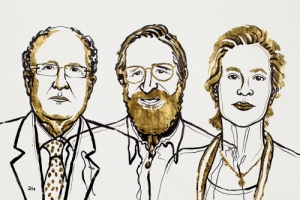
Frances Arnold, Gregory Winter and George Smith controlled evolution in the lab to produce greener technologies and new medicines.
Ways to speed up and control the evolution of proteins to produce greener technologies and new medicines have won three scientists the 2018 Nobel Prize in Chemistry.
Chemical engineer Frances Arnold, at the California Institute of Technology in Pasadena, is just the second woman to win the prize in the past 50 years. She was awarded half of the 9-million-Swedish-krona (US$1 million) pot. The remaining half was shared between Gregory Winter at the MRC Laboratory of Molecular Biology in Cambridge, UK, and George Smith at the University of Missouri in Columbia.
Arnold carried out pioneering work in the 1990s on ‘directed evolution’ of enzymes. She devised a method for inducing mutations in enzyme-producing bacteria and then screening and selecting the bacteria to speed up and direct enzyme evolution. These enzymes, proteins that catalyse chemical reactions, are now used in applications from making biofuels to synthesizing medical drugs.
“Biology has this one process that’s responsible for all this glorious complexity we see in nature,” she told Nature shortly after the prize announcement on 3 October. But although nature operates blindly, scientists know what chemical properties they want to get from an enzyme, and her techniques accelerate natural selection towards those goals. “It’s like breeding a racehorse.”
Antibody breakthrough
In 1985, Smith pioneered a method known as phage display. The technique uses a bacteriophage — a virus that infects bacteria — as a host that displays a protein on its outer coat, allowing researchers to find other molecules that interact with the protein. Winter developed and improved this technology, and invented ways to use it to evolve antibodies adapted for use as human therapeutics. Today, antibodies evolved using this method can neutralize toxins and counteract autoimmune diseases.
The first humanized antibody, called adalimumab (Humira), was discovered by Cambridge Antibody Technology — a company that Winter co-founded in 1989 — and was approved for treating rheumatoid arthritis in 2002. It is also used to treat psoriasis and inflammatory bowel diseases. In 2017, it was the world’s top-selling drug, generating revenues of $18.4 billion.
Scepticism abounded when the company was founded, says co-founder David Chiswell, and it struggled to find investors. “It was one of the earliest generations of European biotechs,” says Chiswell, who is now chief executive of Kymab, an antibody company also in Cambridge. “It was exciting times because we didn’t know what we were doing. And nobody in the world believed that antibodies were really good.”
Cold reception
Arnold also faced an uphill battle when she put forward the idea of evolving proteins in the lab, says Dane Wittrup, a protein engineer at the Massachusetts Institute of Technology in Cambridge. At the time, researchers thought that they would be able to sit down at a computer and rationally design proteins to carry out specific functions. “It was counter-cultural at the time,” he says. “But now, by and large, directed evolution is how the work is done.”
Nicholas Turner, an organic chemist at the University of Manchester, UK, agrees. “Pretty much every enzyme that is used for commercial-scale application will have been through some form of directed evolution,” he says.
Winter previously told Nature Biotechnology that he was lucky because the Laboratory of Molecular Biology had given him “carte blanche” to get on with his work without distinguishing between pure and applied science. “It would have been very difficult to have made my inventions on classic grant funding (it would have been seen as too applied) or on industry money (it would have been seen as too early, and anyway most companies weren't interested in antibodies at the beginning),” he said.
When asked about the impact of Brexit on UK science during a press conference on 3 October, Winter expressed some optimism. “So long as it’s not made difficult for us or more difficult than it is in the moment, then I think it won’t be too much of a problem,” he said. But, he added, if it becomes difficult to bring in top-ranked researchers from the rest of Europe, the outlook could be grim. “We need to stress to the government that they could end up killing a lot of UK science,” he said.
Winter also said that his drive to push his research out of the laboratory and into the clinic came from an early encounter with a woman with cancer who had received an early, experimental version of one of his humanized antibodies against a cancer-related protein. When Winter warned her that the effects of the therapy might not last, she told him not to worry: she only needed to live for a few more months, so that she could help her dying husband. “I was so choked by that,” Winter says..
During the prize announcement, Claes Gustafsson, chair of the Nobel Committee for Chemistry 2018, noted the benefits of the researchers’ work for humanity: “Our laureates have applied principles of Darwin in the test tubes, and used this approach to develop new types of chemicals for the greatest benefit of humankind.”
Female laureates
Before Arnold, the last woman to win the Nobel Prize in Chemistry was Ada Yonath, a crystallographer at the Weizmann Institute of Science in Rehovot, Israel, who won in 2009 for mapping the structure of the ribosome, which generates proteins from the genetic code in cells. Before her, the most recent woman to win was crystallographer Dorothy Hodgkin, in 1964. Arnold is just the fifth female winner in the prize’s history. In 2016, she won the Millennium Technology Prize for her research.
Arnold was “stunned” when she received the call from Stockholm in the middle of the night. “It took me a minute to collect my wits.” She says that she realized early on how powerful her methods could be. “It was clear to me right away, but not yet to the rest of the world.”
And her favourite applications of directed evolution have yet to be realized. One of her dreams is to create an enzyme that can take carbon dioxide from the atmosphere and convert it to materials and fuels.
Nature 562, 176 (2018)
 Twitter
 Facebook